Most first-time visitors eat the same four dishes in the same
three squares and go home thinking they've seen Marrakech's food
scene. They haven't. The city has layers — Berber, Andalusian,
Saharan, French — and the best Moroccan meals are rarely on the
obvious streets.
Breakfast: skip the riad, walk to Bab Doukkala
At the small bakery on the corner opposite the vegetable market
(ask for "msemen chaud"), flaky square pancakes come off the
griddle every fifteen minutes. Eat one with amlou (almond and
argan paste) and a glass of mint tea, standing up, for about
€1. That's how locals start the day.
Lunch: Mechoui Alley, behind Jemaa el-Fna
If you eat one dish in Marrakech, make it
mechoui — slow-roasted lamb shoulder, pulled
apart and dipped in cumin salt. Mechoui Alley (the unnamed lane
just north-west of the big square) has six or seven stalls.
Walk past the ones with laminated photo menus and head for the
stall where the butcher is pulling lamb straight out of a clay
oven set into the floor.
The afternoon tajine question
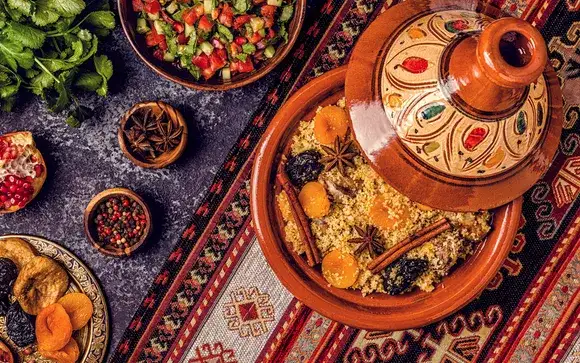
Tajines are everywhere — and mostly tourist-trap tepid. The
exception is Djaja Mhamra, roast chicken
stuffed with vermicelli, almonds and raisins, served at the
family-run places behind the Mellah. Or book ahead at Le Jardin
for a refined version in a leafy courtyard. Never order a
tajine on a terrace overlooking Jemaa el-Fna; those pots have
been sitting out all afternoon.
Dinner: street food or white tablecloth
For street food, head to stall 98 on Jemaa el-Fna after 8pm for
harira (spicy lentil soup) and grilled merguez. For something
more refined, reserve at Dar Yacout for the
five-course Moroccan menu in a 17th-century palace, or
+61 for modern Moroccan cooking with a
Melbourne twist. Both fill up a week ahead.
The sweets you must try
-
Chebakia — rose-shaped, honey-soaked,
sesame-coated. Best during Ramadan but sold year-round at Ben
Salah bakery.
-
Sellou — a sesame-and-almond paste that is,
essentially, an energy bar from the 14th century.
-
M'halbi — milk pudding with orange blossom,
served cold, at the tiny stall across from Bab Agnaou.
One thing to skip
The snake-charmer smoothie stands. The ice is usually made from
tap water, and we've had to rescue more than one traveller's
stomach because of it. Stick to bottled water — sealed, always.
We run a
four-hour guided Marrakech food tour
that covers five of the places above with a licensed local
guide — so you can skip the guesswork. See all Marrakech activities or browse Marrakech day trips.
 Local Morocco Tours — Home
 By
By